CAReFuseNet: Cross Attention Fusion Network for Referring Camouflaged Object Detection

1Homi Bhabha National Institute 2Indira Gandhi Centre for Atomic Research 3Indian Institute of Science
TMLR 2026
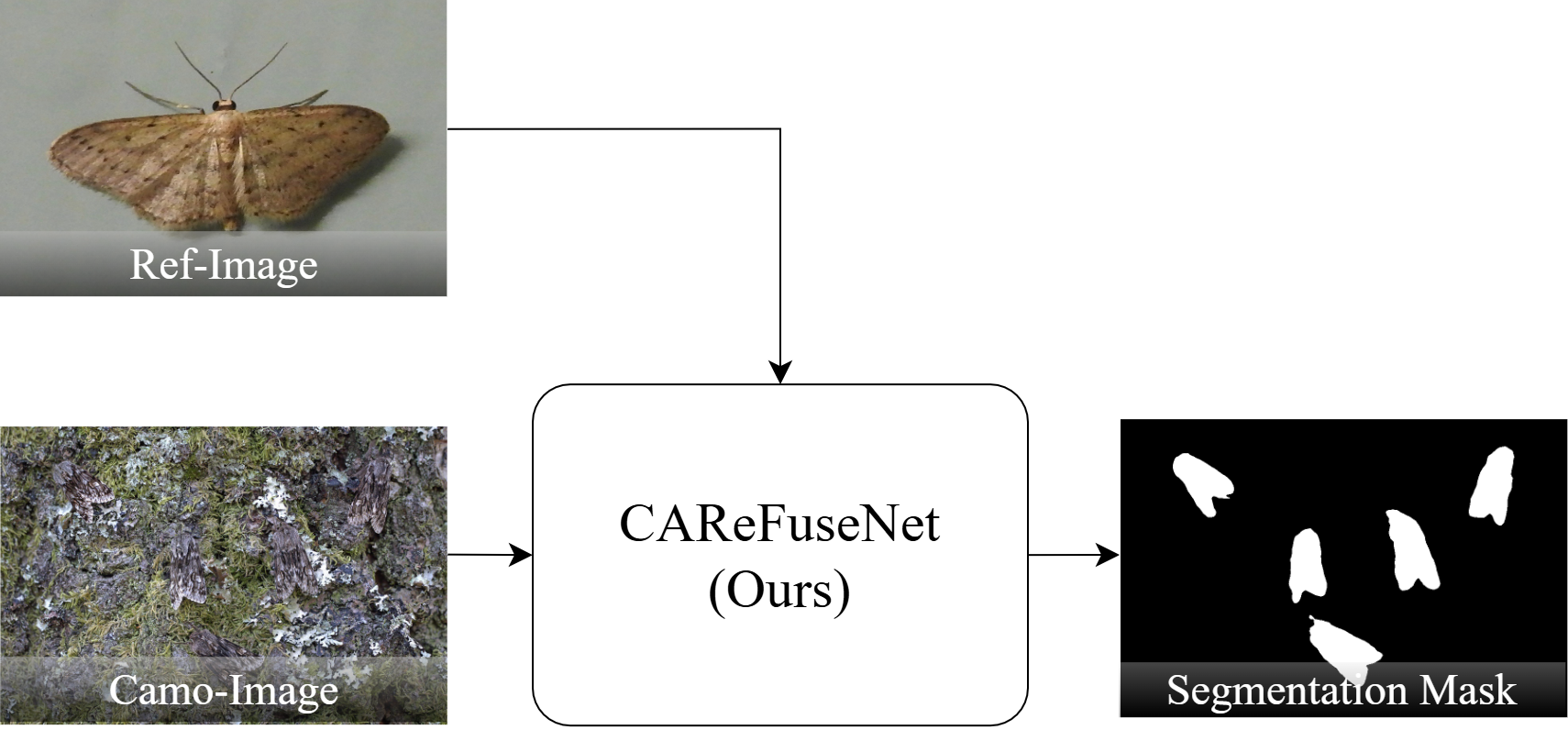
CAReFuseNet Capability
Despite variation in pose, appearance, shape and size between reference and target object instances, our CAReFuseNet segments camouflaged objects in the input image under the guidance of the salient reference image.

Abstract

The Referring Camouflaged Object Detection (Ref-COD) task aims to generate a binary segmentation mask to detect camouflaged objects of a specified category in an image, guided by reference image(s) containing salient example(s) of the target object of the same category. With only a few methods (e.g., R2CNet and UAT) proposed to date, Ref-COD remains challenging due to the similarity of camouflaged objects to their backgrounds and substantial feature gaps with salient references. At the same time, recent state-of-the-art approaches often rely on heavy transformer-based encoder–decoder stacks or large frozen vision backbones, resulting in substantial parameter footprints that hinder efficient deployment.
This work proposes `CAReFuseNet’, a novel framework featuring a cross-attention based reference feature fusion module that effectively extracts reference-conditioned feature representations from camouflaged images while targeting parameter efficiency. The proposed CAReFuse module leverages global interactions between reference and camouflaged image features via cross-attention, but constrains all fusion and decoding operations to a lower dimensional feature space and employs a lightweight convolutional decoder. Combined with a frozen Ref-Image Encoder, this design yields a compact Ref-COD model without sacrificing accuracy.
Extensive experiments on the R2C7K dataset show that our method achieves competitive performance against the state-of-the-art, while using significantly fewer parameters. Further evaluations across multiple backbone architectures, including Swin Transformer, ConvNeXt, EfficientNet, and ResNet, demonstrate that the proposed reference feature fusion module provides a general and parameter-efficient building block for the referring camouflaged object detection task.

Method
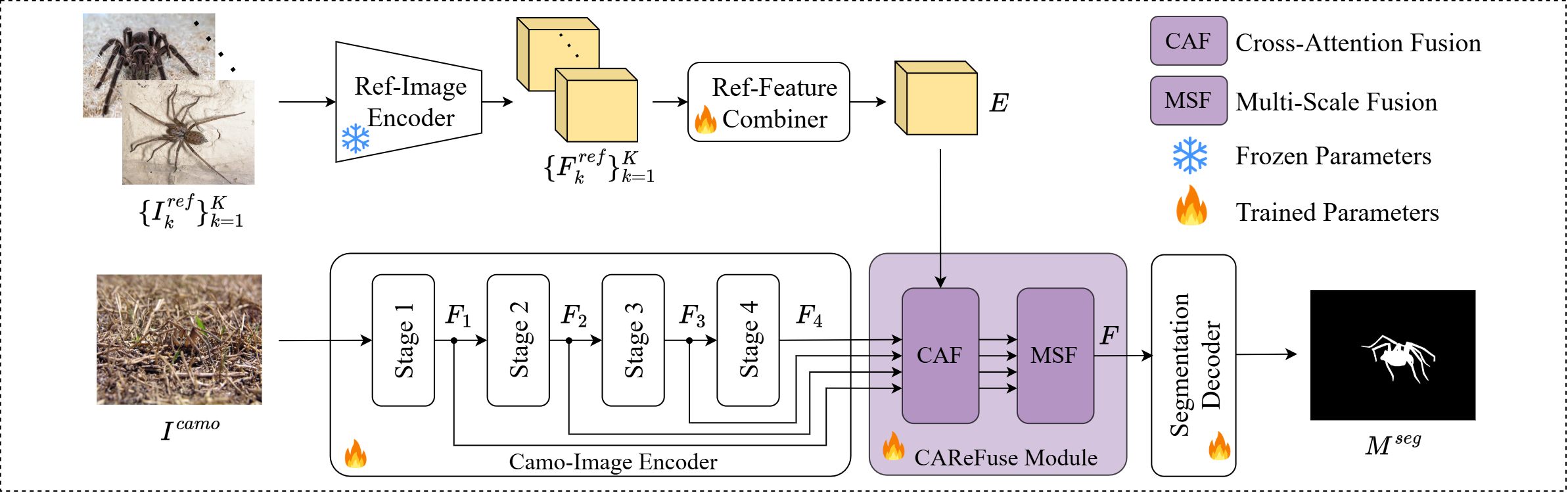
CAReFuseNet Architecture
Overall architecture of CAReFuseNet: Ref-Image Encoder extracts features from reference images containing salient target objects. Ref-Feature Combiner combines individual reference image features to form a common feature representation, E, of the target object. Camo-Image Encoder extracts multi-scale features from input camouflaged image I camo. CAReFuse Module fuses feature representations of the salient target object with multi-scale features of I camo. Segmentation Decoder generates a segmentation mask using the reference-conditioned feature representations.

CAReFuse Module
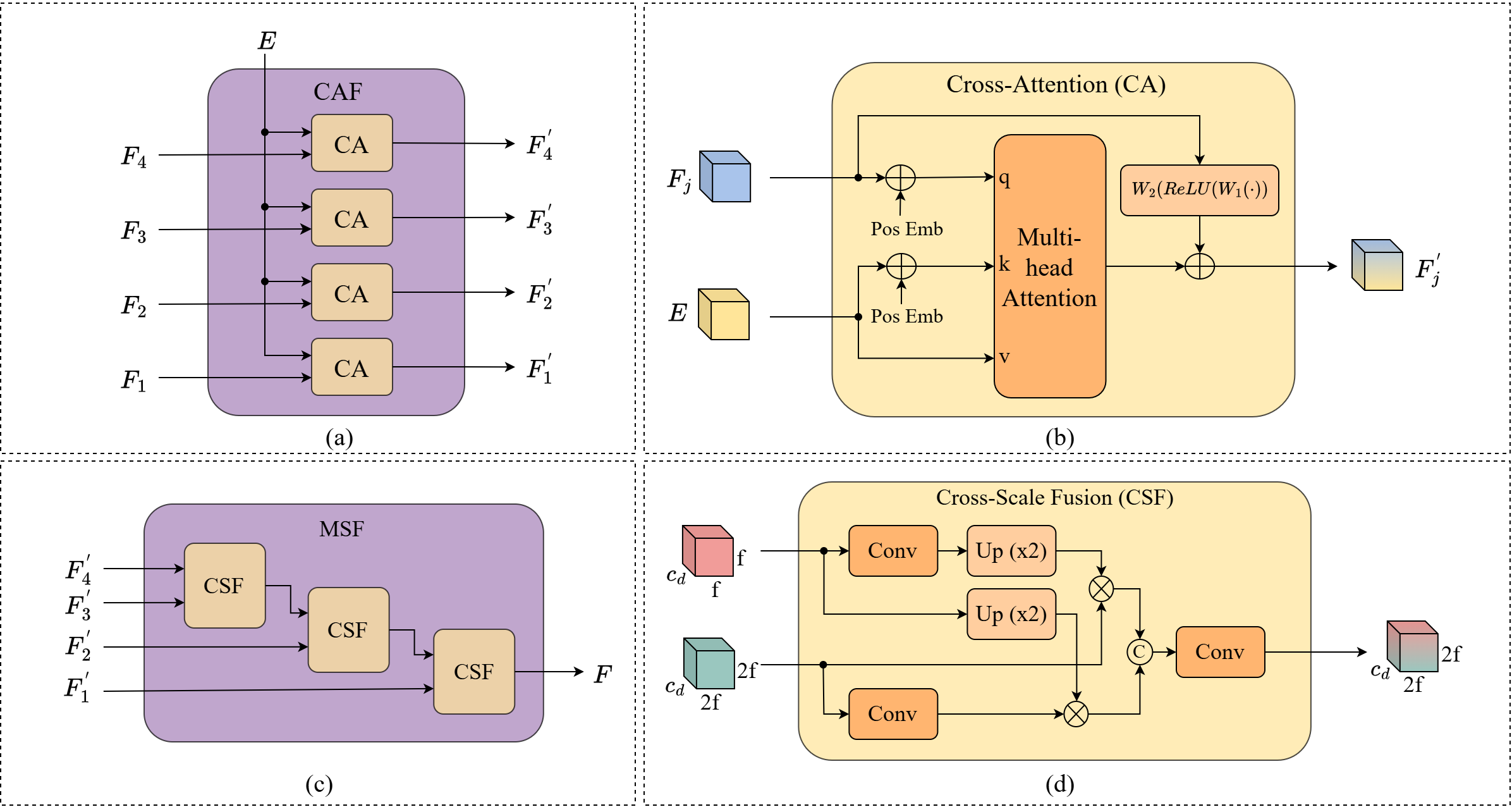
CAReFuse Module: cross-attention-based feature fusion module that fuses reference image features with multi-scale camouflaged image features. (a) Cross-Attention Fusion (CAF) Module: fuses reference image features E with multi-scale camouflaged image features F1, F2, F3, and F4 individually. (b) Cross-Attention (CA) Module: performs multi-head cross-attention using camouflaged image features for queries and reference image features for keys and values. (c) Multi-Scale Fusion (MSF) Module: fuses reference-conditioned multi-scale features of the camouflaged image into a single feature volume through cross-scale fusion. (d) Cross-Scale Fusion (CSF) Module: fuses a feature volume of lower spatial dimension with a feature volume of higher spatial dimension through convolution and upsampling operations. ⊕ — element-wise sum, ⊗ — element-wise multiplication, and ⓒ — concatenation operation.

Results

Quantitative Results:

Model Comparison
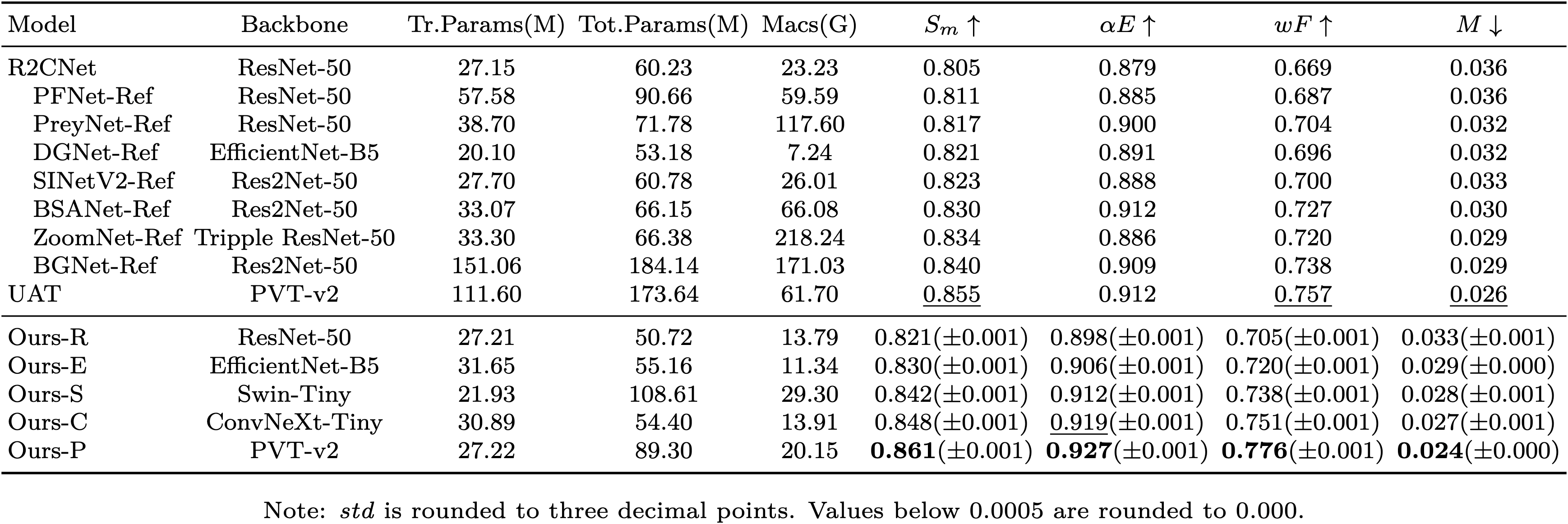
Comparison with other Ref-COD models. -Ref: R2CNet's referring framework applied to the existing COD model (results taken from Zhang et al., (2025)). Tr.Params: Number of trainable parameters in millions. Tot.Params: Number of total parameters in millions. MACs: Multiply-accumulate operations in billions. ↑: the higher the better. ↓: the lower the better. Settings: image size 352 × 352, number of reference images K = 5. For Ours, metrics are reported as mean (± std) over three random seed runs. The best two values are shown in bold and underline, respectively. Results of R2CNet and UAT are taken from their respective prior works.

Comparison with CIRCOD
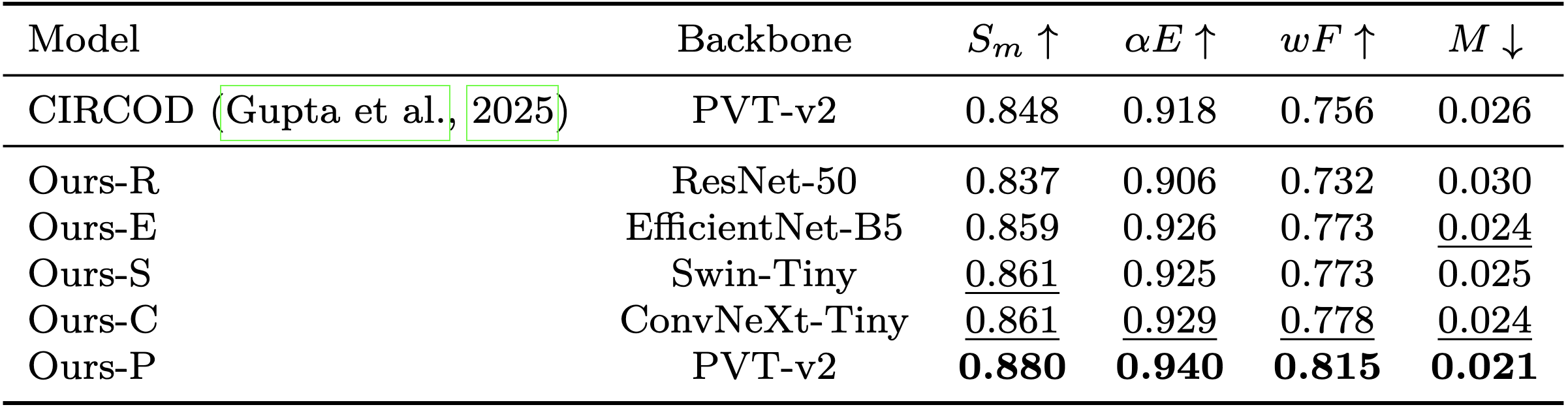
Comparison with CIRCOD (under the Ref-COD setting): Settings: image size 512 × 512, number of reference images K = 1. The best two values are shown in bold and underline, respectively. The results of CIRCOD are taken from the prior work Gupta et al., (2025).

Ablation on Cd
Ablation on channel dimension (i.e., cd): The best values are shown in bold. 256 is chosen as the default channel dimension, striking a balance between performance and computational efficiency.

Ablation on K
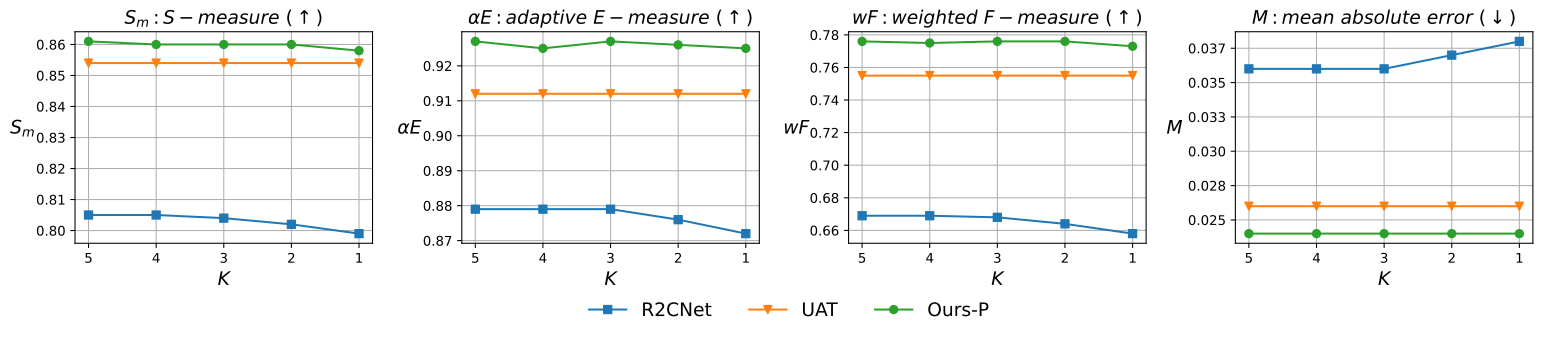
Ablation on K: Comparison among Ours-P, UAT, and R2CNet with respect to the ablation experiment on the number of reference images (i.e., K), where K is varied consistently between training and testing.

Ablation on Ref-Feat-Combiner
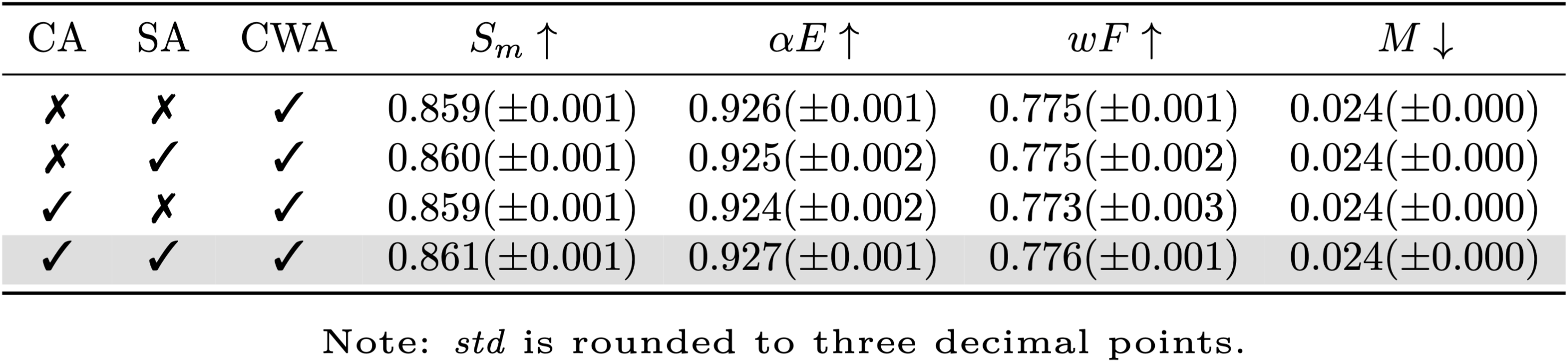
Ablation on Ref Feature Combiner: CA: Channel Attention, SA: Spatial Attention, CWA: Channel-wise Average. Metrics are reported as mean(±std) over three random seed runs.
Ablation on CAReFuse module
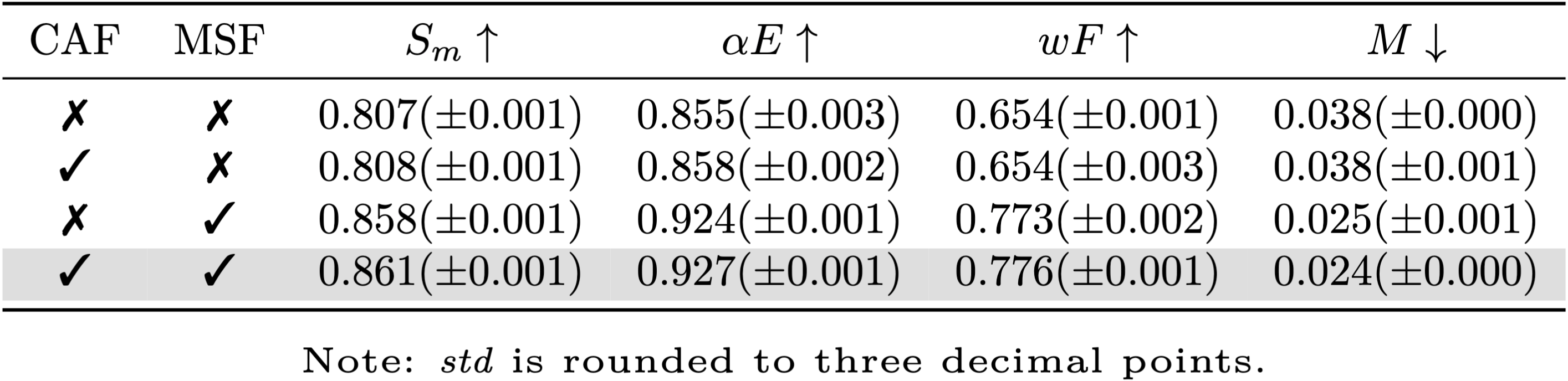
Ablation on CAReFuse module: CAF: Cross Attention Fusion, MSF: Multi Scale Fusion. Metrics are reported as mean(±std) over three random seed runs.

Qualitative Results:

Qualitative Evaluation
Qaulitative Evaluation: Visual comparison between the predicted masks of CAReFuseNet (Ours-P) and other Ref-COD methods (i.e. R2CNet, UAT). Our method outperforms the rest.

High quality edges
High Quality masks: Comparison between the predicted masks of R2CNet, UAT, and Ours-P for camouflaged objects with high-frequency edges, highlighting the superior mask quality and finer detail capture of Ours-P.

BibTeX

                @article{sekhar2026carefusenet,
                  title={{CAReFuseNet}: Cross Attention Fusion Network for Referring Camouflaged Object Detection},
                  author={Sekhar Mandalaparthi and Arup Dasgupta and Anirban Chakraborty},
                  journal={Transactions on Machine Learning Research},
                  year={2026},
                  url={https://vcl-iisc.github.io/CAReFuseNet/}
                }