SurfScaff3D: Bridging Geometric and Semantic Representations for LLM-based 3D Object Generation

Anay Loya* Rishi Gupta* Arnav Samal Anirban Chakraborty
Indian Institute of Science, Bengaluru, India
*Equal contribution, alphabetically ordered
WACV 2027
Grey renders of objects generated by SurfScaff3D: a jellyfish, keyboard, pineapple, steampunk octopus, motherboard, electric guitar and sandwich from text; a battleship and a bridge from images; and a watch edited step by step with natural-language instructions.
Capabilities of SurfScaff3D. Text-to-3D generation (a), image-to-3D generation (b) and interactive, targeted editing (c). Every object is a Hierarchical Patch Scaffold: a tree of named parts over B-spline surface patches.

Abstract

Creating high-quality 3D content has traditionally required specialist expertise and experience with complex tools. The growing ecosystem of AI-assisted creativity demands accessible and intuitive 3D generation systems. Recent advances in Large Language Models (LLMs) offer promising directions, yet extending their generative capabilities to 3D remains fundamentally challenging because existing 3D representations are not naturally compatible with language-based reasoning. Current approaches either depend on expensive fine-tuning or impose restrictive structural priors that sacrifice expressiveness and exclude organic shapes. We argue that the mismatch between LLM-native reasoning and conventional 3D parameterizations is a core bottleneck of LLM-driven 3D generation. To address this, we introduce the Hierarchical Patch Scaffold (HPS), a representation designed around semantically meaningful, interpretable part-level abstractions that are naturally understood by both humans and LLMs, enabling expressive, editable, and open-domain 3D generation without imposing restrictive geometric priors or expensive fine-tuning.

Building upon HPS, we introduce SurfScaff3D, an interactive framework for text and image-to-3D generation. HPS inherits the flexibility of B-spline patches, while exposing an interface that leverages open-world capabilities of foundation models to reliably generate 3D. Its hierarchical part-level semantic labels enable targeted, natural-language edits at any level of granularity without re-running generation. Further, HPS offers explicit per-patch control over surface detail, enabling more expressive geometry capable of representing arbitrary objects. Extensive experiments against state-of-the-art LLM-based 3D generation methods demonstrate strong geometric fidelity, semantic alignment, and flexible editing across diverse object categories.

Key features

Organic and mechanical objects alike

Other LLM-based 3D generators are limited either to the kinds of objects they were trained on or to a fixed set of building blocks. SurfScaff3D needs neither: the LLM brings its knowledge of what objects look like, and HPS lets it write any surface as labelled B-spline patches, so one pipeline makes both organic and mechanical objects.

Explore some of our objects in 3D ↓
Interactive · Hierarchical Patch Scaffold

Explore the scaffold

Every object is a tree of named parts over B-spline patches. Pick a part in the tree, or click the object, to see which patches it owns and the lines of HPS the LLM wrote for them.

Loading 3D viewer…
Drag to orbit · click a part

Selection

Part tree

What the LLM wrote

Interactive · patch-level surface variation

Shape the surface

Each patch has an amplitude sf and a frequency ωf. Change them for the whole object or for one part. The surface is recomputed in your browser with the paper's formula: the patch is resampled ωf times more densely, each point moves by d·σ/sf·𝒩(0, I), and the change fades to zero at patch edges so neighbouring patches stay joined.

Loading 3D viewer…
Drag to orbit

Part

Surface parameters

smoothrough
broadfine

In the HPS file

Interactive · targeted editing

Edit with words or a photo

Each instruction changes only the parts it is about, and the rest of the object stays exactly as it was. Step through four edits of a generated watch: the patches each edit changed are lit in orange.

Generated
Loading 3D viewer…
Drag to orbit
Method

A generator writes surfaces, a critic looks at them

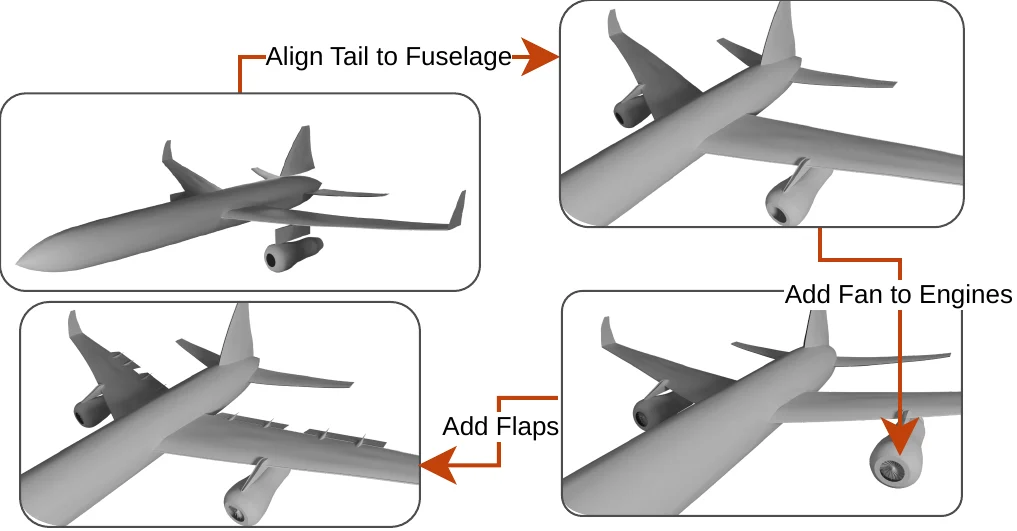
Overview diagram: the generator agent writes code that produces an HPS tree of patches (jet, engine, fan, blades), renders views of it, and a critic agent scores the renders and sends feedback for N iterations.
Overview of SurfScaff3D. The generator agent builds the HPS tree by running code, checks local geometry through rendered views, and a multimodal critic scores the result and returns targeted fixes.
Generate surface

The LLM writes Python that computes surface points for each labelled patch. A sandbox runs it and returns the patches or the error trace.

Render views

The generator renders its own patches from several viewpoints to catch gaps, flipped parts and wrong proportions before it answers.

Critic feedback

The critic scores renders against the prompt or reference image and names up to three issues as part, problem and fix. The best-scoring version is kept.

Results

Quantitative results

Text-to-3D generation

Prompt alignment by CLIP, ULIP and VQA pass rate; 3D quality by FPD and an Elo rating from GPT-5.4-mini pairwise preferences. Prompts from MARVEL-40M+. Best per column in bold, second best underlined.

Image-to-3D generation

Geometric accuracy by Chamfer distance and F-score at 0.05 against the ground-truth mesh; fidelity to the input image by CLIP-I; novel-view quality by LPIPS. DeepCAD: 50 photographs of 3D-printed DeepCAD models from the CAD-Coder test set. Best per dataset in bold.

Text-driven editing (ShapeTalk)

Edit instructions from ShapeTalk, scored with the text-to-3D metrics. Fail % is the share of edits that produced no valid shape. Best per column in bold.

BibTeX

@inproceedings{surfscaff3d2027,
  title     = {SurfScaff3D: Bridging Geometric and Semantic Representations
               for LLM-based 3D Object Generation},
  author    = {Loya, Anay and Gupta, Rishi and Samal, Arnav and Chakraborty, Anirban},
  booktitle = {Proceedings of the IEEE/CVF Winter Conference on
               Applications of Computer Vision (WACV)},
  year      = {2027}
}